DCA meets the bitcoin halving: how to DCA across the 4-year cycle, and should you time it
Every few years, "the halving is coming" gets dusted off again, and there's always someone hoping to buy the dip before it or scoop the bottom in the bear market. I want to talk this through properly: what cycle awareness is actually good for, and why, for a DCA investor, the answer is exactly "don't use it to time the market."
Every so often, the phrase "bitcoin halving" heats up all over again. Communities start counting down the days, article headlines line up to read "the last chance to get on board before the halving," and even friends who barely follow crypto will ask me: shouldn't I buy a bit before the halving? I spent seven years as a traditional financial advisor and later DCAed into bitcoin myself, and I'm both familiar with — and wary of — this urge to "time around some particular moment." In this piece, I want to lay out the halving, the cycle and DCA, all three together, and make them clear.
First, the basics: what the bitcoin halving actually is
Let's get the concept straight first, so the strategy talk makes sense afterwards. New bitcoin is created through "mining": each time the system mines a certain number of blocks, it rewards the miner with some bitcoin. The halving refers to this block reward being cut in half roughly every four years. It's a rule written into the protocol, not a decision someone makes on a whim.
The design intent is clear: to make new coins issue more and more slowly, with the total supply approaching a fixed cap. In other words, what the halving changes is the increment of supply — fewer new coins flow into the market each day. Note that it governs only the "new supply" side; it does not directly dictate what the price should be. This point comes up again and again later, so please keep it in mind.
While we're at it, let me correct a common slip: some people call a 50% price drop a "halving" too, but that's a different thing entirely. The halving in this article means, from start to finish, the protocol event of the block reward being cut in half — it has no literal connection to whether the price rises or falls.
The first time I explained the halving to a client, his eyes lit up: "So supply shrinks — shouldn't the price rise then?" I said: in theory, tighter supply "might" support the price, but the market has long known exactly when the halving lands, and for this kind of public, predictable event, part of the expectation is usually already reflected in the price before it actually happens. Treating the halving as a hidden starting pistol is where a lot of people first stumble.
That legendary "four-year cycle"
Because the halving comes roughly every four years, many people boil bitcoin's price action down to a "four-year cycle" too: a build-up around the halving, a stretch of strength afterwards, then a peak and a roll-over into a bear market, and then the wait for the next halving. This bull-bear narrative has spread widely, and it sounds tidy enough.
I won't deny that something resembling this rhythm has shown up in the past. But I have to put one sentence in the most visible place possible: past patterns do not represent the future. To date, bitcoin has only been through a handful of halvings — a sample so small that any "pattern" has no statistical meaning to speak of. A line drawn through a few points can be called a cycle, or it can be called coincidence, and the market structure, the participants and the macro environment shift with every round.
So my attitude towards the "four-year cycle" is this: treat it as a piece of background common sense worth knowing, not as a timetable you can copy your homework from. Knowing that the market has bulls and bears, ups and downs, helps you withstand the swings; but if you're counting on it to pinpoint "bottoms on this date, top on that date," then you've mistaken a rough historical rhythm for a precision forecasting tool.
Why everyone wants to time around the halving
Once you understand the cycle narrative, you understand why so many people want to make a play around the halving. The temptation is actually pretty plain: if the bull-bear pattern really holds, can't I buy low and sell high, and optimise this "dumb method" called DCA a little further?
The specific fantasies usually take one of two forms. One is "the pre-halving ambush": going in heavy before the halving arrives and the market takes off, waiting for the post-halving rally. The other is "bottom-fishing the bear": buying big all at once at the cycle's low, picking exactly the cheapest moment to act. The core of both ideas is the same — both believe you can identify the key moments within the cycle.
The urge is perfectly normal; I've felt it myself. Who doesn't want to buy the lowest and dodge the falls? But the more alluring an idea, the more it's worth coolly taking apart to see whether it actually holds up.
The problem is: timing really is hard
This is the section I most want you to remember in the whole piece, so I'll go into a bit more detail.
First, the "low" you think you see is invisible at the time. Every beautiful bottom on the chart after the fact is something you only know with hindsight. In the moment, when the price has fallen you don't know whether it'll fall another half; when it's risen you don't know whether it's a bounce or a reversal. "It must be a low before the halving" is wishful thinking too — the period before a halving could just as easily be halfway up a rally. Bottoms and tops only take shape long after they've passed.
Second, emotion betrays you at exactly the critical moment. This is the script I saw most in my advisory years. The person who planned to "bottom-fish the bear" — when the bear bottom actually comes, with blood in the streets and the news talking it down day after day — nine times out of ten doesn't dare to act, because at that point every signal is screaming "it'll get worse." And the person who planned to "escape the top" — when the euphoric peak actually arrives — can't bear to leave, always feeling there's more to come. The moment that demands the most rationality from you is exactly the moment you're least rational.
Third, missing a few of the best days costs you shockingly dearly. Most of the market's gains often cluster into a tiny handful of days, and those days frequently sit right next to the most panicked falls. Trying to dodge a fall by stepping aside, you very easily end up missing the violent rebound that follows close behind. This phenomenon has been discussed at length in traditional markets: sit out a few of the biggest up-days and your long-term return takes a sharp hit. Timing your way in and out, you're betting that you'll never miss those days — which is almost impossible.
Reliably bottom-fishing and top-escaping is an ability almost no one has — even plenty of professional institutions can't do it over the long run. If you genuinely can, then you don't need DCA, and you don't need this piece of mine. I'm writing this to speak for those of us ordinary people who admit we can't. There's no shame in admitting it; it's precisely the starting point that lets you hold on.
So you see, the point of DCA isn't "how accurately you buy" — it's "not having to guess." It takes the question of "when to buy," that daily torment almost no one answers correctly, and hands it once and for all to discipline: when the time comes, buy, no questions about the price. What it gives up is the fantasy of bottom-fishing and top-escaping; what it gets in return is the calm of not having to wrestle your own emotions every day. To the matter of timing around the halving, DCA's answer is crisp and clean — it simply doesn't need you to time anything. On whether lump-sum buying or DCA is the better choice, I've written separately in DCA vs. lump sum — which is better?, which you can read next.
DCA plus cycle awareness: how to balance the two
That said, is knowing the cycle exists completely useless? Not quite. Cycle awareness has its place — it's just that the place is not "a timing tool" but "a mindset guardrail." The difference is enormous, so let me break it down.
The main thread is always: keep DCAing, come what may. Whether the halving has arrived or passed, whether right now is being called a bull or a bear, you invest that fixed amount when the time comes. This is the foundation; every bit of "cycle awareness" below is just a little psychological adjustment built on top of it, and it never wavers the main thread.
So how exactly do you use cycle awareness? Just two things, both about "don't do anything dumb" rather than "make the right move":
- Don't panic-stop in the bear market. When you know the market has bulls and bears, and that a deep drop is a normal part of the cycle rather than the end of the world, then when the account is a sea of red you find it easier to tell yourself: this is just the cycle's trough, and a low price is exactly when DCA should be glad — the same money buys more shares. Cycle awareness here helps you hold firm and not pull your hand away. On how to actually hold through a bear market, I've written specifically in In a bear market, how do you actually hold on?.
- Don't go all-in at the bull-market peak. Conversely, when everyone's euphoric, even the old man downstairs is talking crypto, and you can't resist throwing your whole savings in, cycle awareness reminds you: this kind of mass exuberance has historically tended to appear near a stage high. Its job is to help you stay your hand — don't get carried away into leverage, don't put in money beyond your spare money. On whether you should keep investing in a bull market at all, I've also written The bull is here — should you keep DCAing?.
See the difference? The correct uses of cycle awareness are all defensive, vague, meant to rein in emotion — "don't panic," "don't get carried away" — not offensive, precise, meant to catch the moment — "bottom-fish now," "escape the top now." The former helps you keep your discipline; the latter lures you back onto the old road of timing.
If your fingers really are itching to buy a bit more when it's cheap, there's a steadier path too: turn that impulse into a rule rather than going by feel. For instance, setting "if the price pulls back by a certain amount from a recent high, invest an extra tranche per a pre-set rule" — this is so-called smart DCA. Its merit is handing the judgement to rules written in advance rather than the emotion of the moment; its costs and pitfalls I've laid out in Smart DCA (buying more on dips): is it worth it?. But remember, this is an advanced option; for newcomers I still recommend the dumbest kind: fixed time, fixed amount.
Down at the level of tools, making your DCA "automatic" is the single most important step — people will find excuses to skip in a big drop and want to add more in a big rally. Platforms like Binance support setting up an automatic DCA plan; once it's set, it buys for you on schedule, you don't have to place each order by hand, and that's far fewer chances for emotion to interfere. Hand "sticking with it" over to the system, not to your daily mood.
A few common misconceptions after the halving
Around every halving, a few misconceptions are especially prone to popping up; let me puncture them all at once.
Misconception one: halving = an instant rise. This is the most widespread misreading. What the halving changes is the issuance rate of new coins, and this supply-side change is slow, only potentially showing over the long run — it absolutely doesn't mean the price should jump on the day or in the week of the halving. Treat the halving as a starting pistol for a rally and you're very likely to cut your losses in disappointment when it "doesn't cash out immediately."
Misconception two: ignoring that "the expectation is already priced in." The halving's date is public, known to everyone. There's an old market saying, "buy the rumour, sell the news": for an event already discussed to death, the price often digests part of that expectation before it actually happens (in plain terms, it's "priced in"). By the time the halving really lands, the reaction can be anticlimactic. Expecting an event the whole world knows about to deliver you a surprise is itself a bit unreasonable.
Misconception three: treating the "halving year" as a special year to add more. Some people think: since the halving is coming, I should invest more this year. But this circles back to timing — you're still betting on the uncertain direction that the halving will bring a rise. For a DCA investor, the halving year is essentially no different from any other year: spare money, a fixed amount, invested on schedule, and that's it.
Misconception four: treating three or four historical samples as iron law. "It went up after every previous halving" — that sounds like evidence, but the sample is too small to prove causation or rule out luck. Each round's participant structure, sources of capital and macro rate environment differ; using three or four points to infer that the fifth must play out a certain way doesn't hold up statistically.
The long-term conclusion: crossing cycles is the slow road to wealth
Having gone round in a circle, we come back to this site's underlying colour: slow wealth.
If you accept everything above — that the halving is a supply rule rather than a price switch, that the four-year cycle is a rough historical rhythm rather than a timetable, that almost no one can time reliably — then the conclusion follows quite naturally: real long-term thinking isn't carefully bottom-fishing and top-escaping within one halving cycle; it's letting your DCA cross multiple halving cycles, using time to average out the bull-bear swings of any single cycle.
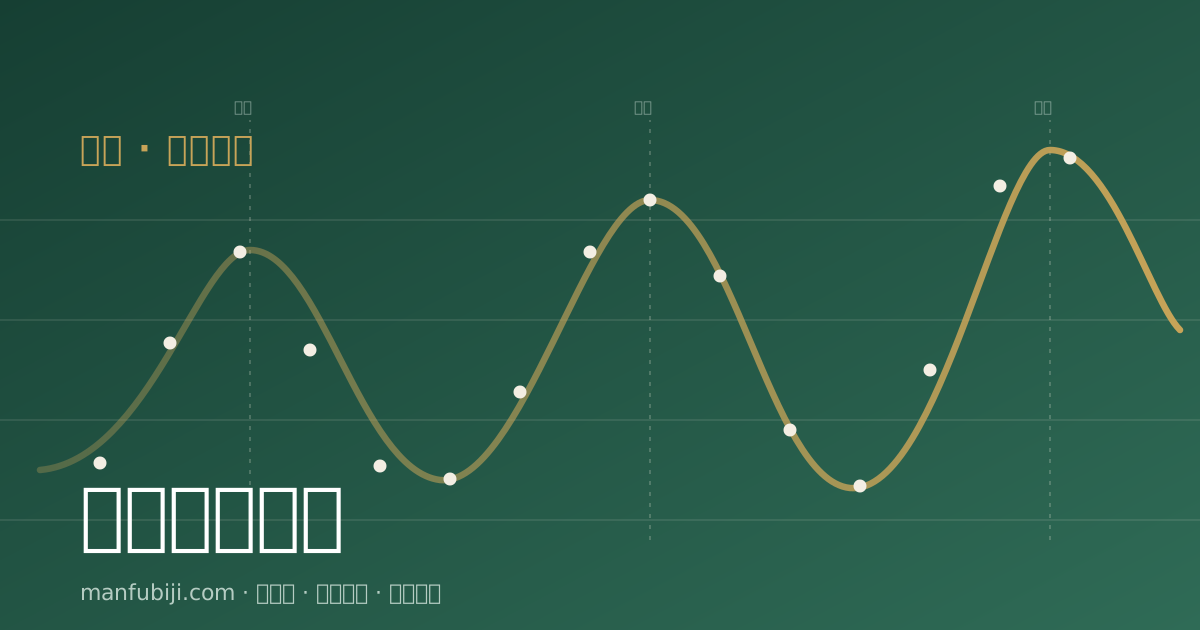
Picture that rising-and-falling cycle curve, then picture your DCA as a string of evenly spaced little dots landing uniformly on the curve's highs, lows and mid-slopes. Look at any single dot and you can't say whether you bought well; but join up all the dots across several years and several halvings, and your average cost lands in a relatively smooth band, rather than being staked on a single day of a single halving. This is the power of DCA crossing cycles — it doesn't need you to win at any one moment, it wins on time itself.
So when the next wave of "the halving is coming" rises again, you don't have to fret over whether to ambush or to bottom-fish. You just return to that iron rule: spare money only, on a horizon of years, buy when the time comes, set it up and don't watch it daily. The halving will come, and it will pass; the bull will come, and the bear will come too. And your quiet string of little dots simply keeps falling into time. That, as I understand it, is slow wealth.
If you want to understand this whole DCA business from the most basic ground up, start with this foundational long read — The Complete Bitcoin DCA Guide: from zero to your first buy. It covers "what it is, why, how much, how long, and how to set it up" all in one go.
Done agonising over "should I wait for the halving"?
The premise of DCA crossing cycles is having an account that can buy automatically and doesn't rely on you judging the timing every day. Once you've read this and confirmed the method suits you, it's never too late to start — here are the specifics on opening an account and setting up automatic DCA.
Disclosure: if you enter this site's Binance invite code BN1516 when you register, Manfu may receive a referral fee, and you pay nothing extra. Investing carries risk; the content is for education only and is not investment advice.
FAQ
Will bitcoin definitely rise after the halving?
Not necessarily. The halving only cuts the issuance rate of new coins in half; what it affects is the supply increment, and it does not directly determine the price. Historically there have indeed been rallies after a few halvings, but the sample is only three or four — not enough to be meaningful, not proof of causation, and no guarantee that the future will repeat. Treating the halving as a sure-thing signal and going in heavy is a very dangerous idea.
Should you wait for the halving before you start DCA?
I wouldn't delay starting just to wait for the halving. The whole premise of DCA is that you don't need to judge the timing, and waiting for the halving is itself a form of timing. Nobody can know in advance which moment is best, so rather than wait empty-handed for months or even a year or two, it's better to start DCA running with a small amount and let time work for you. Starting early and being able to keep going matters far more than picking the perfect entry point.
Should you add to your DCA in the halving year?
In principle there's no need to bump up your amount because of the halving narrative. The halving has long been public information, so the market has very likely already priced that expectation in, and topping up on impulse is essentially betting on a direction you can't call. If you genuinely want to buy a bit more cheaply in a bear market, go with rules-based smart DCA rather than piling in on the excitement of the halving.
How many halving cycles should DCA span to make sense?
DCA is a thing measured in years; ideally it spans at least one — and better, several — full halving cycles. If you only watch the few months around a single halving, what you're seeing is mostly noise. Stretch the horizon out over several years and the mechanisms of smoothing your cost and riding through volatility get room to work, while the bull-bear swings within the cycle get averaged out by time.
Should you stop DCA in a bear market?
As long as you're still investing spare money and can still sleep at night, a bear market is precisely when you should least stop. A low price means the same money buys more shares; stopping means voluntarily giving up the cheapest chips in the cycle. The time you genuinely need to pause is when your life cash flow runs into trouble and that money is no longer spare — not because the account turned red and your nerve gave out.